Plastic Manufacturing Processes by Venture Plastics Distributors

Finding the Right Plastic Manufacturer

Venture Plastics Distributors supplies products for a vast number of industries. We specialise in serving the mining, construction, and road safety sectors.

Experience has allowed us to understand that these industries need safety products that will clearly and safely demarcate areas while keeping costs low. Therefore, plastic is the smart choice. This material lends itself to a wide range of applications. By understanding the end-use requirements, we can manipulate it to be flexible, and robust, or play as a perfect host to additional sturdy or reflective materials.

We are proud that over the past 12 years we have refined our internal processes and manufacturing abilities to provide the market with diverse and innovative products. Items that simplify design, keep costs low and still improve usability and durability.

In this blog, we take you through our two product manufacturing processes and how our choices positively impact our clients.

Our Considerations When Choosing Plastic Manufacturing Processes

Here are the main factors we carefully consider when picking a manufacturing process for the plastic safety products we keep on hand for you.

Volume/cost:

How much of each product do we need to have on hand and how often will we need to restock? These answers are the decider for our chosen plastic manufacturing processes. We generally choose what makes us incur lower costs so we can always offer our clients the most affordable choice.

Form/size:

How complex are the parts? Are there difficult internal features or tight tolerance requirements? Depending on the design and size, manufacturing options may be limited or may require major design for manufacturing optimisation to make them economical to produce.

Lead time:

How quickly do we need to produce parts or finished products if we need to restock after a large sale? Some processes take 24 hours, while others can take months. It all depends on the volume and form.

Rotation Moulding

This is a favourite option for manufacturing hollow plastic products. Also called rotomoulding, it’s ideal for producing large, intricate shapes with an identical wall thickness and high-quality finish.

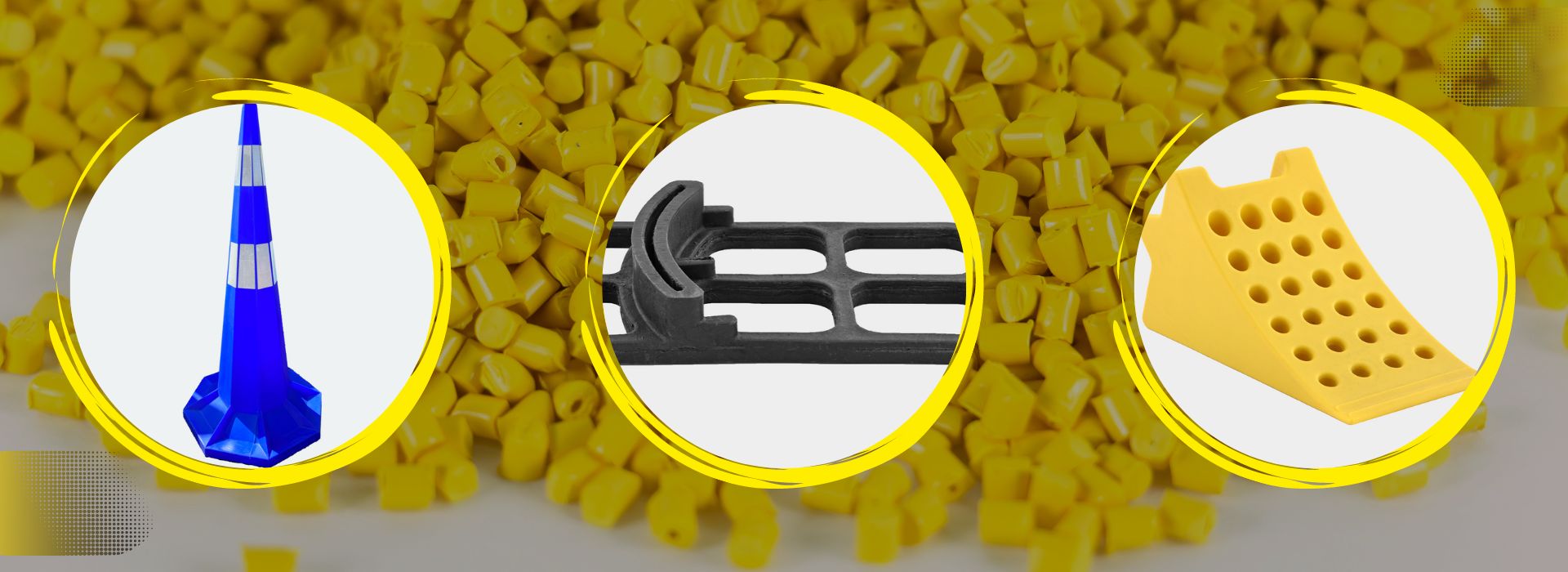
Waterfilled barriers and 1.8m safety cones are examples of the kinds of items we create using this process.

Rotomoulding is one of the easier manufacturing processes to follow as it is reliably precise.

When producing in smaller quantities of 3000 products or less, it is usually the most cost-effective option. The cost of the parts or product is low relative to its size.
Rotational moulding ensures that items are durable, stable, and strong.

How Rotomoulding Works

During this process, powdered plastic resin is placed into the mould before heating. The closed mould enters a heating system or oven and rotates bi-axially. Allowing the plastic resin to melt and coat the inside of the mould evenly, slowly and precisely.

The heat melts the plastic into a single or double layer that conforms to the shape of the mould while leaving the interior of the final product hollow.
Then a water spray cools the mould while still rotating to solidify the plastic. When rotation stops, the mould opens and the plastic part is removed.

Injection Moulding

Injection moulding is used for large-volume manufacturing. This process enables us to produce many components in a short space of time. From tiny parts to large components like stop blocks, delineator bases and posts.

Injection moulding produces way more product units compared to rotomoulding and some other plastic manufacturing processes. This option also lends itself to the design and production of more intricate parts and designs.

How Injection Moulding Works

First, a design is created internally and a this is developed into a mould.

Thereafter, a thermoplastic polymer is heated above its melting point, resulting in the conversion of the solid polymer to a molten fluid with a reasonably low viscosity. This melt is mechanically forced, and injected, into a mould in the shape of the desired final object.

A hydraulic press closes the mould, and then small plastic pellets get heated and extruded by a screw.

The molten plastic gets injected into a mould. Cooling happens within the mould until is solid enough to be ejected. Then at the end, sprues and runners are removed from the part.

The Ideal Plastic Product Manufacturer

At Venture Plastics Distributors, we prioritise keeping stock on hand for our clients and ensuring all that we offer is at the most affordable rate. Therefore, we don’t usually create custom designs. This allows us to hold as much stock as possible for affordable product listings.

We always have products on hand as and when you need them. Our products are strong, and reliable and are designed to be able to withstand the harsh and diverse African climates.

Contact Us

010 023 7178

10 Log Road, Roodekop, Germiston, Gauteng 1422

Enquire Today


    * indicates a required field

    error: Content is protected !!